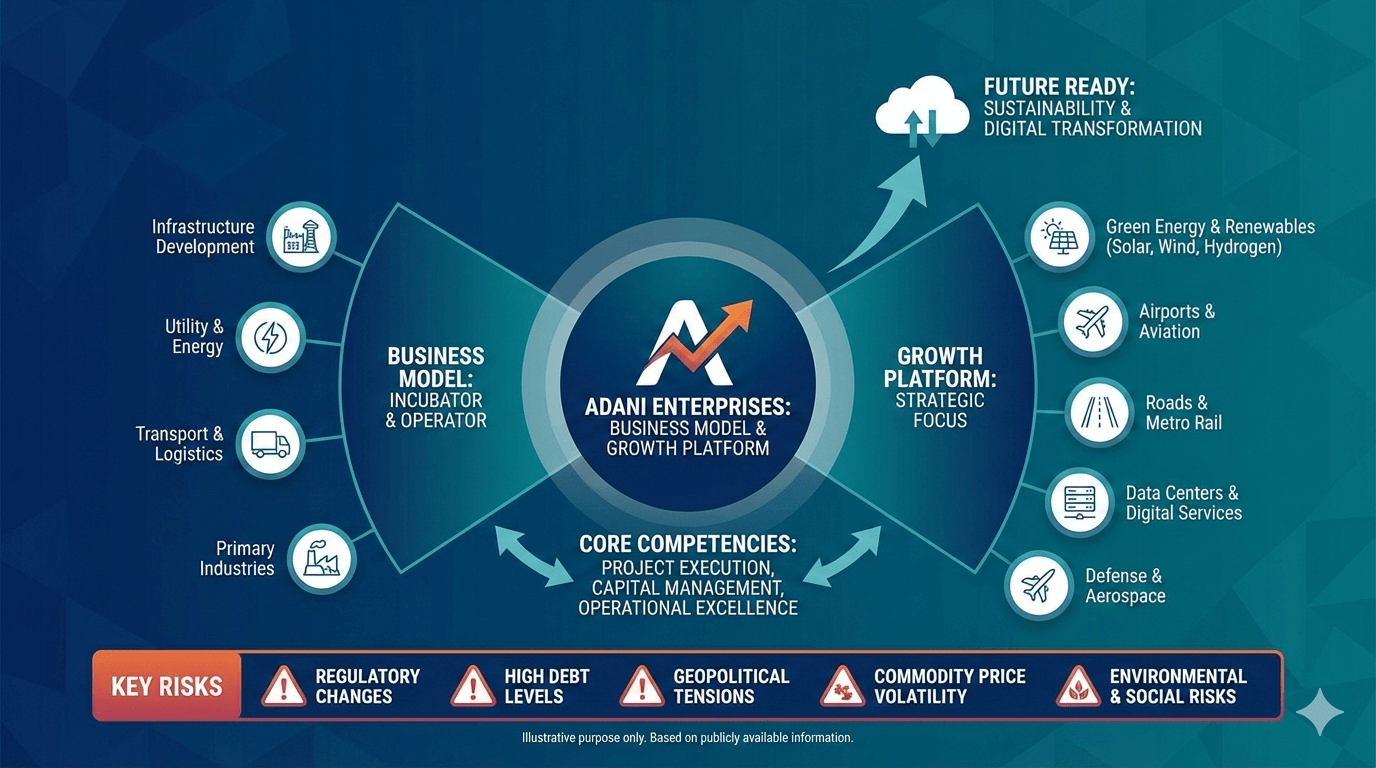
Adani Enterprises: The Business Model Behind India’s “Incubator” for Infrastructure and Energy Platforms
Adani Enterprises is not a conventional conglomerate where every business line is meant to remain under one roof forever. The more accurate way to understand it is as a platform builder and incubator: it identifies large, structurally growing parts of India’s economy—transport, logistics, urban infrastructure, energy transition, and industrial supply chains—builds operating capability at scale, then expands those platforms with long-horizon capital and execution-heavy projects.
For retail investors, that difference matters. You are not buying a neatly packaged portfolio of stable divisions. You are buying an organization that is often early in the lifecycle of big infrastructure businesses—where value can be created quickly through scale and operating execution, but where earnings can also be uneven because growth requires heavy investment.
A useful mental model is: Adani Enterprises is the group’s “factory for new engines.” Mature assets often sit elsewhere in the broader ecosystem, while Adani Enterprises tends to be where newer, faster-growing, more capital-intensive platforms are built.
1) The core economic idea: build scarce assets in fast-growing markets
Most of Adani Enterprises’ key businesses share a common logic:
They operate in markets with structural demand growth (India’s trade, urbanization, energy needs, mobility, and industrialization).
They require permits, scale, relationships, and long-term capital—barriers that reduce the number of credible competitors.
Once built, many become asset-backed “choke points” in real-world infrastructure: airports, logistics corridors, industrial supply chains, and energy systems.
When that works, the payoff can be significant because infrastructure tends to generate long-duration cash flows and can support adjacent growth (for example: an airport can support cargo, real estate, ground services, and commercial revenue).
2) How Adani Enterprises makes money in practice
A) Infrastructure platforms with regulated or contracted characteristics
A number of assets in the Adani ecosystem are effectively long-duration infrastructure concessions or contracted businesses. The economic appeal is that revenue can be more predictable than in purely discretionary consumer markets, because usage is tied to macro activity (trade, travel, industrial throughput).
Where Adani Enterprises participates in such platforms, the value creation typically comes from:
winning concessions or contracts
improving utilization and throughput
expanding capacity
driving non-aeronautical or ancillary revenue streams
using scale to reduce unit costs
B) “Build, scale, integrate” in logistics and industrial supply chains
A second profit pool comes from activities that sit around heavy industry and supply chains: sourcing, trading, services, and logistics layers that monetize volume, relationships, and execution reliability.
These businesses tend to be more cyclical than a pure concession model, but they can generate strong cash flow when demand is supportive—especially if the operator has:
procurement leverage
integrated logistics advantages
reliable execution and service quality
The key investor point is that this layer can amplify earnings in good cycles, but it can also compress quickly in weak cycles. Retail investors should expect some volatility here.
C) “Energy transition manufacturing” and next-generation industrial bets
Adani Enterprises has also been associated with building future-facing platforms—industrial-scale clean energy supply chains and next-generation manufacturing ecosystems.
The business model here is different from traditional infrastructure:
upfront capital intensity is high
margins and returns depend on technology choices, supply chain execution, and policy economics
timelines can be long before cash flows become stable
If this segment succeeds, it can create very large optionality and strategic value. If it struggles, it can create earnings drag and funding pressure. Investors should treat this area as a portfolio of long-dated options rather than near-term predictable profit.
3) The “incubator” playbook: how value is created
Adani Enterprises typically creates value through a repeatable sequence:
Identify a structurally large market where scale and execution are advantages
Secure strategic access (concessions, land, long-term contracts, partnerships)
Build operating capability (execution, procurement, compliance, staffing)
Scale fast to lower unit costs and raise utilization
Integrate adjacent revenue streams (services, logistics, commercial revenue)
Recycle capital when appropriate (through restructuring, partnerships, or shifting mature platforms elsewhere)
In that sense, Adani Enterprises behaves more like a long-horizon developer-operator than like a classic “holdco of finished assets.”
4) Why the model can work: the three structural advantages
A) Access and execution in regulated environments
Large infrastructure projects require navigation of regulation, permitting, and long-term stakeholder management. A company that can execute consistently gains repeat access to new opportunities.
B) Scale as a cost advantage
In infrastructure and logistics, scale often becomes a moat because it improves:
purchasing power
financing access (when markets are supportive)
operating efficiency
ability to invest in capacity ahead of demand
C) Ecosystem effects across platforms
A group building across transport, logistics, and energy can create practical synergies:
shared procurement
shared land and industrial zones
shared customers and contracts
shared logistics routes and handling capabilities
Synergies should not be romanticized—execution matters—but the ecosystem angle helps explain why the group often thinks in platforms, not standalone assets.
5) The tradeoff investors must accept: capital intensity and “lumpy” earnings
If you buy Adani Enterprises expecting smooth quarter-by-quarter compounding, you may be disappointed. The model is fundamentally build-and-scale, which means:
large capex cycles
periods where depreciation, interest, and startup costs rise faster than revenue
earnings that can look “messy” while projects ramp
This is not automatically a negative. Many of the world’s most valuable infrastructure businesses looked financially uneven during their buildout phases. The key is whether projects transition from investment mode to cash generation on a reasonable timeline.