Introduction
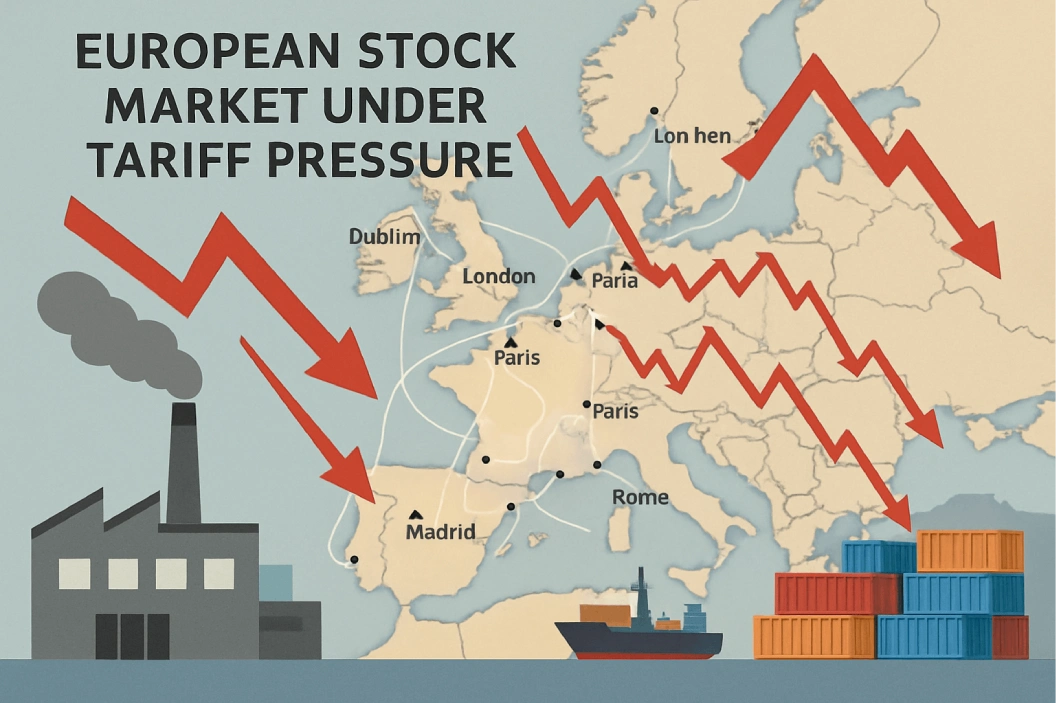
European stock markets and trade policy are now inseparable forces shaping valuations, volatility, and financial stability. As global trade shifts from rules-based to power-based systems, Europe’s equities face sharper exposure to tariffs, supply-chain disruptions, and retaliation risks.
Key thesis
Export dependence and value-chain depth raise beta to trade policy: euro area equities and banks show significant drawdowns when trade policy uncertainty rises, with effects compounding over weeks and months as firms guide down margins and capex.
Policy shocks transmit via multiple channels: tariffs, non-tariff barriers, FX swings, higher working-capital needs, and risk-premium repricing—all amplified by elevated policy uncertainty and fragmented geopolitics identified in ECB stability analysis.
Event evidence
ECB analysis links a 1-standard-deviation rise in trade policy uncertainty to immediate and persistent declines in euro-area bank equity prices, highlighting the financial-stability channel and pro-cyclical tightening of conditions.
In early April 2025, pan-European indices fell sharply on new US tariff announcements and retaliatory measures, with autos and cyclicals leading losses and intraday volatility spiking alongside global equity weakness, demonstrating renewed sensitivity reminiscent of 2018–2019.
Why Europe stands out
Europe’s flagship firms derive material revenues from extra-EU markets and rely on imported critical inputs, especially from the US and China, raising exposure to tariff regimes of 10–20% now discussed in policy circles and executive surveys.
The ECB’s May 2025 Financial Stability Review flags rising trade frictions as a specific vulnerability for the euro area given its openness and supply-chain integration, warning of volatility spikes and credit risks if tensions persist or escalate.
2018–2019 case memory
During the 2018–2019 trade war, EU equities exhibited event-window drawdowns surrounding key tariff announcements and guidance revisions, with autos, industrials, and materials notably sensitive—patterns the ECB now generalizes via uncertainty-shock identification.
These dynamics resurfaced in 2025: headline-driven de-risking produced multi-day sell-offs, followed by partial rebounds, underscoring a repeated market playbook when tariffs dominate the macro narrative.
Sector breakdowns
Autos
High exposure to US and China demand, complex cross-border parts flows, and direct sensitivity to auto-specific tariffs; 2025 headlines prompted pricing changes and output adjustments across major manufacturers, echoing the 2018–2019 experience.
Industrials and materials
Global capex cyclicality makes earnings highly sensitive to trade volumes, input costs, and border frictions; uncertainty compresses order books and multiples in synchronized fashion.
IT and consumer goods
Supply-chain complexity and branding exposure to extra-EU markets raise susceptibility to both tariff costs and demand shocks, while FX volatility can buffet margins.
Finance
Bank equity beta rises through credit risk, collateral valuation, and widening risk premia when trade policy uncertainty rises—identified quantitatively in the ECB special feature.
Scenario analysis: 10–20% tariffs
Broad US tariff regimes at 10–20% would lift landed costs for key EU exports, pressure margins, and encourage supply-chain re-routing with transitional frictions; Germany and Ireland, with surplus exposure to the US, are particularly impacted in survey-based assessments.
ECB and partner commentary warn that shifts and reversals in tariff policy can cause outsized volatility spikes and tightening in financial conditions, with equities remaining sensitive to tariff news even after initial rebounds.
Data-driven angles to include
Uncertainty-shock elasticities for sector returns and banks, drawn from ECB research design and event-study windows around 2018–2019 and 2025 announcements for comparability and robustness.
Qualitative forward-looking risks from Europe’s evolving China dependency in semiconductors, batteries, and critical raw materials, where de-risking—not decoupling—keeps residual exposure elevated.
Portfolio implications
Tilt toward balance-sheet strength, pricing power, and intra-EU revenue concentration during tariff cycles, recognizing that internal market trade provides a partial buffer versus extra-EU shocks in many business models.
Use hedges across FX and commodities; stress-test earnings and working-capital under higher friction costs and elongated lead times; monitor policy-uncertainty gauges highlighted by the ECB as leading risk indicators.
Risk management checklist
Map revenue and supplier splits by US/China exposure; identify tariff pass-through capacity and substitution risk at SKU level; pre-arrange alternative logistics lanes relevant to Red Sea disruptions.
Set triggers tied to tariff-headline frequency and trade-policy uncertainty indices to dynamically adjust gross and net exposure across cyclicals versus defensives, consistent with ECB-flagged sensitivity patterns.
FAQ
What makes European stocks sensitive to tariffs?
High export intensity, complex global value chains, and empirically observed sector betas to policy uncertainty and tariff events.
Are 10–20% US tariffs plausible stressors?
Executive and policy discussions consider ranges of 10–20%, which would materially raise trade costs for EU industries with large US exposure.
Do rebounds negate the risk?
Partial rebounds occurred in April 2025, but equities remained highly sensitive to further tariff headlines, as noted by the ECB’s stability communications.