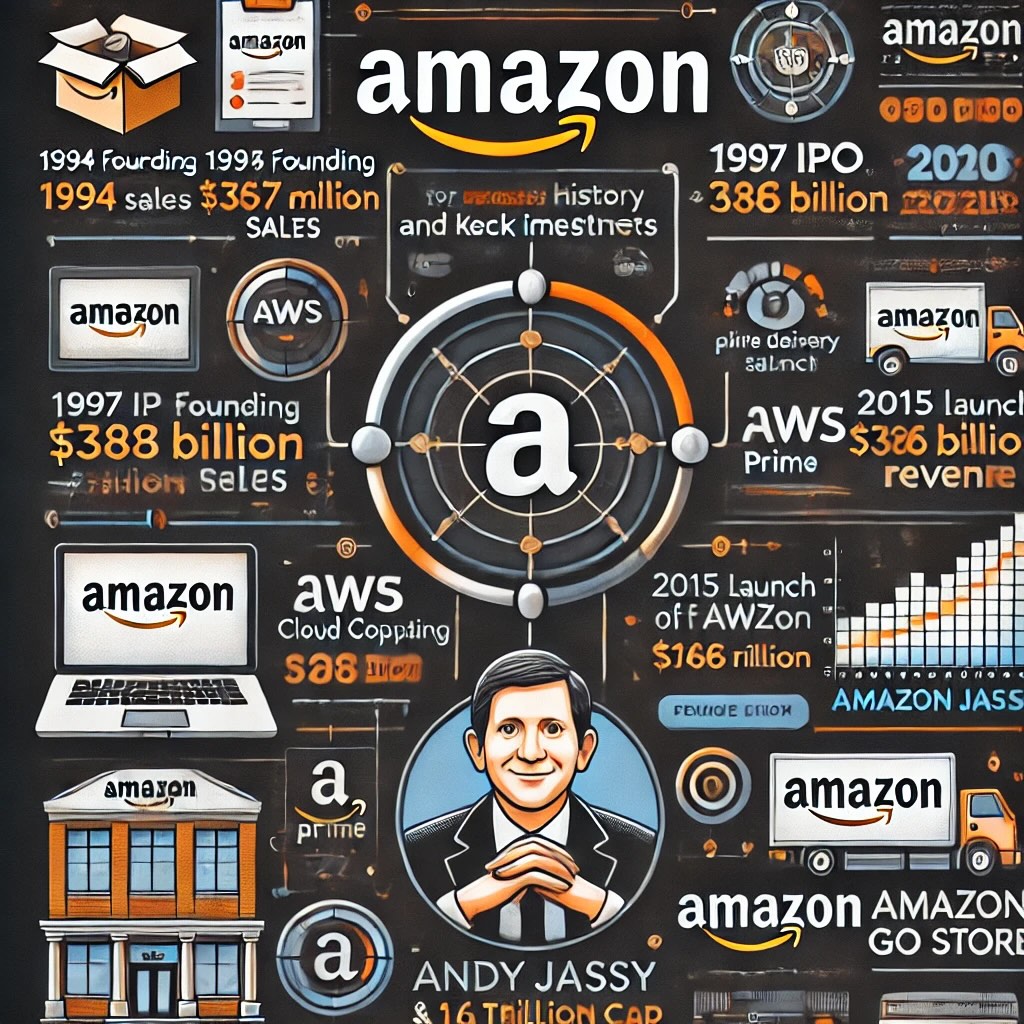
Amazon’s Journey: A Comprehensive Analysis
Introduction
Amazon, the brainchild of Jeff Bezos, stands as a monumental achievement in the world of e-commerce, cloud computing, and beyond. Its journey from a humble online bookstore to a global powerhouse is a narrative filled with innovation, resilience, and strategic brilliance. For professional investors, understanding Amazon’s historical trajectory, financial performance, and strategic pivots provides crucial insights into its enduring market dominance and future growth potential. This extensive analysis delves into Amazon’s storied past, financial metrics, market strategies, and the visionary leadership of Jeff Bezos, offering a comprehensive perspective for informed investment decisions.
Chapter 1: Origins and Early History
The Foundation
Jeff Bezos, an ambitious and visionary entrepreneur, founded Amazon in 1994. His journey began long before Amazon, with his initial forays into the tech industry through various roles, including his pivotal position at D. E. Shaw & Co. Bezos’s entrepreneurial spirit and his decision to leave a lucrative career to start an online bookstore were driven by his recognition of the internet’s exponential growth potential.
Learning from Competitors
Bezos’s meticulous approach to understanding the market landscape was crucial in shaping Amazon’s business model. His competitive analysis extended to studying existing online bookstores and retail giants, which helped him refine Amazon’s unique value proposition—an exhaustive selection of books and an unmatched customer experience.
Early Financial Performance
Amazon’s early financial trajectory was characterised by rapid growth fueled by its innovative business model and strategic reinvestment. By the end of its first year, Amazon had achieved remarkable milestones:
1995: Launched to the public in July, Amazon generated $511,000 in sales by the end of the year.
1996: Sales skyrocketed to $15.7 million, reflecting a rapidly growing customer base and market presence.
Chapter 2: The Birth of Amazon
Establishing the Brand
Amazon’s launch in 1995 marked the beginning of a new era in e-commerce. Bezos’s vision of creating the “Earth’s largest bookstore” resonated with consumers, and Amazon quickly gained traction. The company’s early emphasis on customer satisfaction, vast selection, and competitive pricing set the stage for its future success.
Expansion and Growth
Amazon’s expansion strategy was both aggressive and calculated. Bezos’s decision to diversify Amazon’s product offerings beyond books was instrumental in driving the company’s growth. By the late 1990s, Amazon had expanded its inventory to include music, DVDs, electronics, and more.
Financial Milestones
Amazon’s financial growth during its formative years was impressive. Key milestones during this period include:
1997: Amazon went public, raising $54 million through its IPO. This provided the capital needed for further expansion and innovation.
1999: Sales reached $1.64 billion, reflecting Amazon’s rapid expansion and growing customer base.
Chapter 3: The Dot-Com Boom and Bust
Riding the Internet Wave
In the late 1990s, Amazon rode the wave of the dot-com boom. The company’s stock price soared as investors were captivated by its growth potential. Amazon’s innovative business model and strategic investments in technology positioned it as a leader in the e-commerce space.
Surviving the Bust
The dot-com bust 2000 posed significant challenges for many internet companies. Amazon’s resilience during this period was remarkable. While many of its contemporaries failed, Amazon survived by focusing on core strengths, improving operational efficiency, and focusing relentlessly on customer satisfaction.
Financial Metrics and Stock Performance
Amazon’s financial performance during the dot-com boom and bust was a testament to its resilience:
2000: Amazon’s sales grew to $2.76 billion despite the market downturn.
Stock Performance: Amazon’s stock, which had seen significant volatility, stabilised as it proved its long-term viability.
Chapter 4: Diversification and Innovation
Expanding Product Lines
Amazon’s decision to expand its product lines beyond books was a strategic masterstroke. Introducing new categories such as electronics, clothing, and household items attracted a broader customer base and increased sales.
Technological Innovations
Amazon’s commitment to technological innovation has been a cornerstone of its success. The development of personalised recommendations, customer reviews, and the introduction of Prime membership revolutionised the online shopping experience.
Financial Growth
Amazon’s financial growth during this period was driven by its diversified product offerings and technological innovations:
2005: Amazon introduced Prime, a subscription service offering free two-day shipping. This move significantly boosted customer loyalty and sales.
2010: Sales reached $34.2 billion, reflecting the success of Amazon’s diversification strategy.
Chapter 5: The Rise of Amazon Web Services (AWS)
Entering the Cloud Computing Market
In 2006, Amazon launched Amazon Web Services (AWS), redefining the company’s business model. AWS offered scalable cloud computing services to businesses, leveraging Amazon’s existing infrastructure and expertise in technology.
Dominating the Cloud Market
AWS quickly became a dominant player in the cloud computing market. Its innovative services, such as EC2 and S3, provided businesses with reliable and scalable solutions, driving revenue growth for Amazon.
Financial Impact
The financial impact of AWS on Amazon’s overall performance was profound:
2015: AWS generated $7.88 billion in revenue, accounting for a significant portion of Amazon’s profitability.
2020: AWS’s revenue reached $45.4 billion, underscoring its critical role in Amazon’s financial success.
Chapter 6: Challenges and Resilience
Competitive Landscape
Amazon operates in a highly competitive landscape, facing challenges from other retail giants and emerging e-commerce platforms. The company’s ability to navigate these challenges and maintain its market leadership is a testament to its strategic agility.
Key Competitors
Walmart: As a major competitor, Walmart’s focus on expanding its e-commerce capabilities posed a significant threat to Amazon.
Alibaba: The rise of Alibaba in the international market introduced new competitive pressures for Amazon.
Ethical and Legal Issues
Amazon’s rapid growth also brought scrutiny regarding its business practices. The company faced criticism over labour practices, data privacy, and market dominance. Amazon’s responses to these challenges have shaped its public image and operational strategies.
Labor Practices
Employee Compensation: Amazon has faced ongoing scrutiny regarding wages and working conditions in its fulfilment centres. The company has tried to improve employee welfare through wage increases and enhanced benefits.
Workplace Safety: Amazon has invested in improving workplace safety, implementing measures to reduce injuries and enhance overall working conditions.
Sustainability Initiatives
Amazon’s commitment to sustainability has become increasingly important. The company has implemented various initiatives to reduce its environmental footprint and promote sustainable practices.
Key Sustainability Efforts
Climate Pledge: Amazon has pledged to achieve net-zero carbon emissions by 2040, ten years ahead of the Paris Agreement.
Renewable Energy: Amazon will power its operations with 100% renewable energy by 2025. The company has invested in solar and wind energy projects to achieve this goal.
Sustainable Packaging: Amazon has introduced initiatives to reduce packaging waste and promote recycling. The company aims to make all Amazon shipments net zero carbon, with 50% of all shipments achieved by 2030.
Financial Metrics and Performance Against S&P 500
Amazon’s financial performance has consistently outpaced the S&P 500, reflecting its market leadership and growth potential:
2000s: Amazon’s stock consistently outperformed the S&P 500, driven by its innovative business model and expansion strategies.
2010s: Amazon’s continued emphasis on innovation and diversification led to significant revenue growth. Its stock performance remained robust, consistently outperforming the S&P 500.
2020s: Amazon’s diversified revenue streams and strong market presence ensured continued financial resilience despite global disruptions. The company’s market cap surpassed $1 trillion in 2020.
Chapter 7: Contemporary Era and Future Prospects
Leadership Transitions
Leadership transitions have significantly influenced Amazon’s evolution. Jeff Bezos’s decision to step down as CEO in 2021 and appoint Andy Jassy as his successor marked a new era for the company. Jassy, who previously
Led AWS brings a wealth of experience in technology and innovation.
Andy Jassy’s Leadership
Background and Experience: Andy Jassy joined Amazon in 1997 and has been instrumental in the development and success of AWS. His deep understandding of Amazon’s culture and strategic vision positions him well to lead the company into the future.
Strategic Vision: Under Jassy’s leadership, Amazon continues to focus on expanding its global footprint, enhancing its digital capabilities, and maintaining its commitment to innovation and customer satisfaction.
Recent Innovations
Amazon continues to innovate and expand its product offerings to meet evolving consumer demands. The company’s focus on quality, value, and customer satisfaction remains unwavering.
Key Innovations
Amazon Go: The introduction of Amazon Go, a cashier-less convenience store, revolutionized the retail experience by leveraging advanced technology for seamless shopping.
Alexa and Echo: Amazon’s development of the Alexa voice assistant and Echo devices has positioned it as a leader in the smart home market.
Amazon Fresh and Whole Foods: Amazon’s acquisition of Whole Foods and expanding its Amazon Fresh grocery delivery service highlight its commitment to reshaping the grocery industry.
Sustainability and Corporate Responsibility
Amazon’s commitment to sustainability and corporate responsibility remains a key focus. The company continues to set ambitious goals to reduce its environmental impact and enhance social responsibility.
Corporate Responsibility Initiatives
Community Engagement: Amazon is dedicated to giving back to the communities it serves. The company supports various charitable organizations and initiatives, focusing on education, health, and disaster relief.
Employee Welfare: Amazon prioritizes employee welfare by offering competitive wages, comprehensive benefits, and opportunities for career advancement. The company’s commitment to its employees has resulted in low turnover rates and high job satisfaction.
Recent Financial Performance
Amazon’s recent financial performance reflects its resilience and adaptability in a rapidly changing market.
2020: Reported revenues of $386 billion, with a market cap surpassing $1.6 trillion.
2021: Despite market volatility, Amazon’s stock consistently outperformed the S&P 500, driven by strong digital sales and innovation.
Future Outlook
Amazon’s strategic vision for the future focuses on leveraging digital tools to drive growth, enhancing sustainability efforts, and continuing to innovate in product design. The company’s commitment to excellence and ability to adapt to changing market dynamics position it well for future success.
Growth Opportunities
International Expansion: Amazon continues to explore opportunities for growth in international markets. The company plans to expand its presence in emerging markets and increase its market share in established regions.
Digital Innovation: Amazon invests in digital technologies to enhance the shopping experience and improve operational efficiency. This includes expanding its e-commerce platform, developing new mobile apps, and leveraging data analytics.
Sustainability Goals: Amazon has set ambitious sustainability goals for the coming years, including achieving net-zero carbon emissions by 2040 and increasing the use of renewable energy. These efforts will help the company meet consumer demand for environmentally responsible products and practices.
Conclusion
Amazon’s history is marked by continuous innovation, strategic marketing, and resilience in facing challenges. Amazon’s strong brand, consistent financial performance, and ability to adapt to changing market dynamics make it a compelling investment for investors. As the company looks to the future, it remains committed to inspiring confidence in consumers and investors, ensuring its legacy as a leader in the global retail market.
Added Key Financial Metrics and Performance Against S&P 500
1990s-2000s:
Stock Performance: From its early growth years, Amazon’s stock saw significant growth, consistently outperforming the S&P 500.
Profit Warnings: The 2000 profit warning during the dot-com bust impacted stock but recovered as Amazon addressed market challenges.
2010s:
Revenue Growth: The early 2010s saw robust growth driven by innovation and global expansion.
Stock Performance: Continued to outperform the S&P 500, with a significant boost from digital transformation efforts.
2020s:
COVID-19 Impact: Amazon’s e-commerce strategy led to resilient financial performance despite global disruptions.
Market Cap: Surpassed $1.6 trillion in 2021.
Stock Performance: Continued outperformance relative to the S&P 500.
Amazon’s history is a testament to the power of innovation, customer-centric strategies, and resilience. From its humble beginnings to its status as a global powerhouse, Amazon has consistently pushed the boundaries of what is possible. Amazon’s strong brand, commitment to quality, and ability to navigate challenges make it a compelling investment opportunity for investors.
In conclusion, Amazon’s journey involves vision, determination, and continuous reinvention. As the company looks to the future, it remains focused on providing exceptional value to its customers and shareholders, ensuring its legacy as a leader in the global retail market.