• Type:
  • Category:

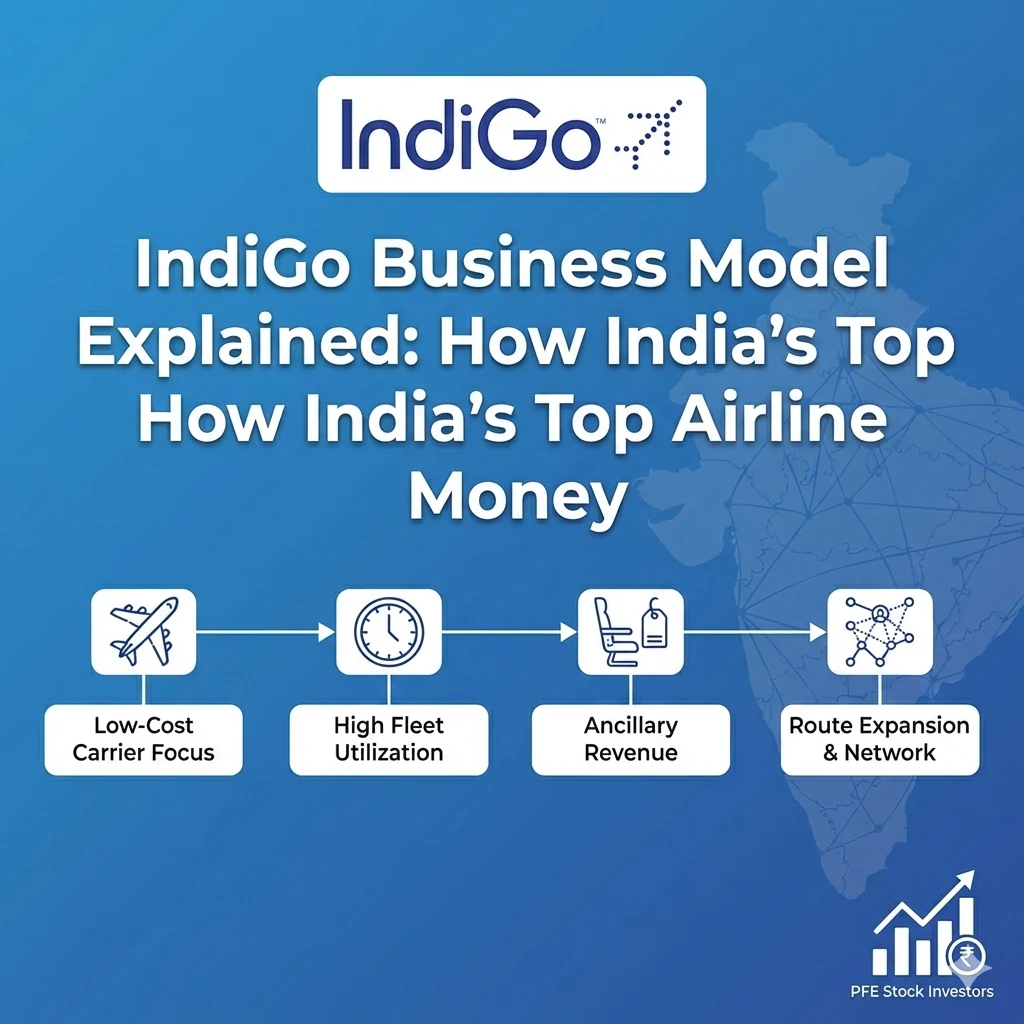
IndiGo Business Model Explained How Indias Top Airline Makes Money

IndiGo is often described with a single phrase: “India’s low-cost carrier.” That description is accurate, but incomplete. What makes IndiGo strategically interesting is not that it sells low fares—it is that it has built an operating system designed to convert India’s structurally growing air-travel demand into repeatable, high-frequency cash generation, while staying resilient through shocks that regularly destabilize airlines: fuel spikes, currency swings, capacity wars, airport constraints, and aircraft availability cycles.
indigo seat11a 2 - IndiGo Business Model Explained How Indias Top Airline Makes Money - seat11a
Picture of Sanjay Oberoi

Sanjay Oberoi

worked for numerous big names in the sector, including Fidelity Investment, Allianz Global Investor, Union Investment, and Kepler Cheuvreux.

IndiGo (InterGlobe Aviation): A Long-Form, Investor-Style Explanation of the Business Model

IndiGo is often described with a single phrase: “India’s low-cost carrier.” That description is accurate, but incomplete. What makes IndiGo strategically interesting is not that it sells low fares—it is that it has built an operating system designed to convert India’s structurally growing air-travel demand into repeatable, high-frequency cash generation, while staying resilient through shocks that regularly destabilize airlines: fuel spikes, currency swings, capacity wars, airport constraints, and aircraft availability cycles.

If you want to understand IndiGo like an equity investor, the right framing is not “an airline that tries to fill seats.” The right framing is: a high-utilization, asset-light (relative to full-service peers), cost-disciplined aviation platform that uses scale, simplicity, and operational reliability to win the mass market—and then monetizes that scale through network advantages, pricing discipline, and ancillary revenue expansion.

Below is a detailed breakdown of how that system works.

1) The core idea: IndiGo sells reliability at scale, not just cheap tickets

Most retail investors focus on the headline: low fares. But in a market like India, low fare alone is not a durable moat. Competitors can match price. What’s harder to copy is a reputation for:

high on-time performance (relative, over cycles)
predictable operations
high-frequency schedules on key routes
fewer cancellations and disruptions
simple, consistent service expectations

That “reliability brand” matters because India’s aviation market includes a large portion of first-time flyers, time-sensitive business travelers, and price-sensitive family travelers. People will pay slightly more—or choose the airline repeatedly—if the probability of “getting there as planned” is higher. In practice, reliability reduces refund costs, reduces rebooking chaos, improves aircraft utilization, and creates a flywheel: more demand → higher load factors → more frequency → more schedule convenience → more demand.

IndiGo’s business model is built to reinforce that flywheel.

2) The operating model: standardization and utilization are the real profit drivers

Airlines make money when they (a) keep unit costs low, and (b) keep planes flying. IndiGo’s model is heavily optimized for both.

Fleet standardization

IndiGo historically emphasized a narrow-body, single-family fleet approach (centered on the Airbus A320 family) because standardization drives:

lower maintenance complexity
simplified pilot training and scheduling
interchangeable crew planning
spare-parts pooling efficiency
faster turnaround at airports
simpler procurement and vendor relationships

Even when an airline expands fleet variety over time (for growth, range, or capacity reasons), the “IndiGo logic” remains: keep complexity contained, keep training scalable, and protect dispatch reliability.

High aircraft utilization

High utilization is not a nice-to-have; it is the economics of the model. If a plane sits on the ground, it earns nothing while lease cost, ownership cost, and staffing cost continue.

IndiGo’s system is designed around:

tight turnaround processes
operational discipline at stations
schedule design that maximizes productive hours
a network that supports consistent rotation of aircraft
centralized control to recover quickly from disruptions

When utilization is high, fixed costs are spread across more seat-kilometers. This is one of the most powerful levers in airline profitability—and one of the hardest to execute consistently in a congested infrastructure environment.

3) The commercial engine: revenue management is where airlines “print” margin

A misconception among non-specialists is that airlines set a price and sell seats. In reality, airlines run a complex, real-time auction: different customers have different willingness to pay, and the airline tries to sell the right seat to the right customer at the right time, while protecting yields.

IndiGo’s model leans on three revenue mechanisms:

Dynamic pricing across fare buckets

Seats are allocated into fare classes. As the flight fills, lower fare buckets close, and average fares rise—assuming demand supports it. If demand is weaker, the airline opens lower buckets and stimulates bookings.

Schedule convenience as a yield lever

IndiGo’s scale allows it to operate more frequencies on key city pairs. Frequency is a competitive advantage because:

business travelers care about timing and flexibility
higher frequency increases the chance a customer picks your flight “by default”
schedule density improves network stickiness

This is how a low-cost carrier can sometimes charge “not-low” fares on high-demand routes—because it sells time and reliability, not only price.

Network effects in a domestic market

In a large domestic market like India, a dense network increases connectivity and recovery options. If one flight is disrupted, re-accommodation is easier within your own schedule. That operational advantage protects customer trust and reduces cost leakage during disruptions.

4) Ancillary revenue: the second profit pool that protects margins

A modern low-cost carrier is not a “ticket-only” business. The base fare is often the entry point; the margin is increasingly built through add-ons.

IndiGo’s ancillary strategy typically includes:

seat selection and upgrades (preferred seats, extra legroom)
baggage add-ons beyond a base allowance
food and beverages onboard
convenience services (priority boarding, flexible change options)
partner-driven commissions (hotels, insurance, transport, experiences)
corporate programs and bundled offerings for SMEs

Why ancillaries matter to investors:

they diversify revenue away from pure fare competition
they can rise even when base fares are under pressure
they can be higher margin than the ticket itself
they improve per-passenger economics without materially raising cost

In airline equity analysis, you can think of ancillaries as a form of “ARPU expansion” (average revenue per user) layered onto the core seat product.

5) Asset strategy: leases, flexibility, and capital discipline

IndiGo has historically leaned on leasing to maintain flexibility. Leasing can be strategically attractive because it:

reduces upfront capital needs
allows faster capacity scaling
enables fleet renewal without massive ownership balance-sheet burden
provides flexibility to return aircraft or renegotiate over the cycle

The tradeoff is that leasing introduces:

long-term fixed commitments
exposure to lease rate cycles
accounting complexity (especially under modern lease accounting standards)

A key airline-investor point: leasing is not automatically “good” or “bad.” It is a tool. In a volatile market like aviation, flexibility can be worth paying for—especially if the airline has the discipline not to over-expand at the top of the cycle.

6) Cost structure: why “low-cost” is an operating culture, not a marketing label

Airlines have a handful of dominating cost lines. IndiGo’s low-cost model focuses on controlling what can be controlled while mitigating what cannot.

Fuel

Fuel is typically the largest cost line, and it is largely outside management control. The model response is:

operational fuel efficiency (flight planning, weight discipline, procedures)
route design that avoids unnecessary holding and congestion exposure where possible
selective hedging philosophy (varies by airline and cycle)
disciplined capacity so that fares can support fuel reality over time

Labor productivity

Low-cost carriers aim for:

higher productivity per employee
streamlined staffing models
standardized processes that reduce headcount per aircraft
tight alignment of incentives around punctuality and operational performance

Maintenance and reliability

Maintenance is both a cost and a reliability driver. The low-cost model emphasizes:

predictable maintenance planning
simplified fleet maintenance through standardization
strong vendor relationships
minimizing AOG events (aircraft on ground) because AOG destroys utilization

Airport and navigation fees

India’s infrastructure constraints mean airports can be cost-heavy and time-heavy. A carrier with scale can:

negotiate better terms over time
optimize scheduling to reduce disruption exposure
build operational know-how in complex airports
leverage volume to secure practical advantages (slots, turn processes)

7) The growth strategy: domestic density first, international expansion next

IndiGo’s growth playbook can be summarized as:

dominate domestic trunk routes and high-demand corridors with frequency
build density in Tier-2 and Tier-3 markets as air travel expands
selectively expand international routes where aircraft economics and demand support it
deepen partnerships to extend network reach without fully bearing long-haul complexity

Domestic density as a defensive moat

In India, domestic demand growth is structural—income growth, urbanization, improved airport infrastructure, and rising business travel all contribute. IndiGo’s scale allows it to be the “default” option in many markets, which makes it harder for competitors to dislodge it without spending aggressively.

International as a margin and brand opportunity (with complexity)

International routes can offer:

diversified demand exposure
potentially higher yields on certain leisure and business corridors
brand visibility beyond India
currency revenue diversification

But international expansion also introduces complexity:

regulatory permissions
different airport cost structures
longer duty cycles and crew complexity
greater disruption exposure across borders

IndiGo’s typical strategic approach is to expand in a way that preserves the low-cost DNA—choosing markets where narrow-body economics or disciplined capacity can still work.

8) Cargo: often overlooked, but strategically useful

Cargo is not always the main margin driver for a passenger airline, but it can be an important buffer:

it monetizes belly capacity that would otherwise go unused
it improves route economics
it can stabilize revenue during passenger demand swings

For investors, the point is not to model IndiGo as a cargo pure play. The point is to recognize cargo as a secondary revenue layer that can smooth cyclicality and improve aircraft economics.

9) Competitive dynamics in India: why discipline matters more than ambition

India is one of the most competitive airline markets globally because:

demand is high but price sensitivity is extreme
infrastructure constraints create operational fragility
new entrants periodically trigger fare wars
macro shocks (fuel, currency, geopolitics) hit quickly

In such a market, the winners are not necessarily the airlines with the most exciting marketing. The winners are the airlines that can:

maintain cost advantage
avoid destructive capacity decisions
preserve liquidity
keep operations stable through disruption
protect brand trust

IndiGo’s model is built around that discipline. The risk for any market leader is complacency or over-expansion. The opportunity is to keep converting scale into reliability, and reliability into repeat demand.

10) The key investor risks (and how to think about them)

Fuel and currency shocks

Fuel cost and currency movements can swing profitability sharply. The question is not “can IndiGo eliminate it?” It cannot. The investor question is: does the airline have enough structural cost advantage and pricing discipline to stay resilient?

Aircraft availability and technical issues

If aircraft deliveries are delayed, or engine issues ground aircraft, utilization and capacity plans can be disrupted. For a high-utilization model, operational reliability at the fleet level is critical.

Infrastructure constraints

Congested airports, slot constraints, and ATC delays can erode turnaround times and reduce utilization. IndiGo’s operational capability is a differentiator here, but it is also a constant battle.

Competitive capacity additions

Fare wars can destroy industry profitability. A disciplined leader tries to avoid being the marginal price-setter while protecting share through frequency and reliability rather than irrational discounting.

Regulatory and tax environment

Aviation is heavily regulated and exposed to policy changes. Investors should treat policy as a recurring variable rather than a one-time risk.

11) What makes IndiGo investable as a business model (the “equity logic”)

For a retail investor looking for professional clarity, IndiGo’s business model stands out because it has:

a structurally growing home market
scale advantages that can become self-reinforcing
a standardized operating system that supports low unit costs
a brand linked to reliability, not only price
multiple revenue layers (fares + ancillaries + cargo + partnerships)
a flexible capacity toolkit (leases, network design, partnerships)

The main question is execution: can IndiGo maintain discipline and reliability while scaling into new markets and managing industry volatility?

Closing thought

IndiGo’s strength is not that it is cheap. Its strength is that it has built a repeatable operational and commercial machine that can serve the mass market at scale while still protecting unit economics. In an industry where many airlines fail by over-promising and under-executing, IndiGo’s model is fundamentally about doing fewer things—very well—over and over again.

OTHER POSTS YOU MIGHT LIKE

Continue your Journey:
More Financial Results Presentations

CATEGORIES

Scroll to top