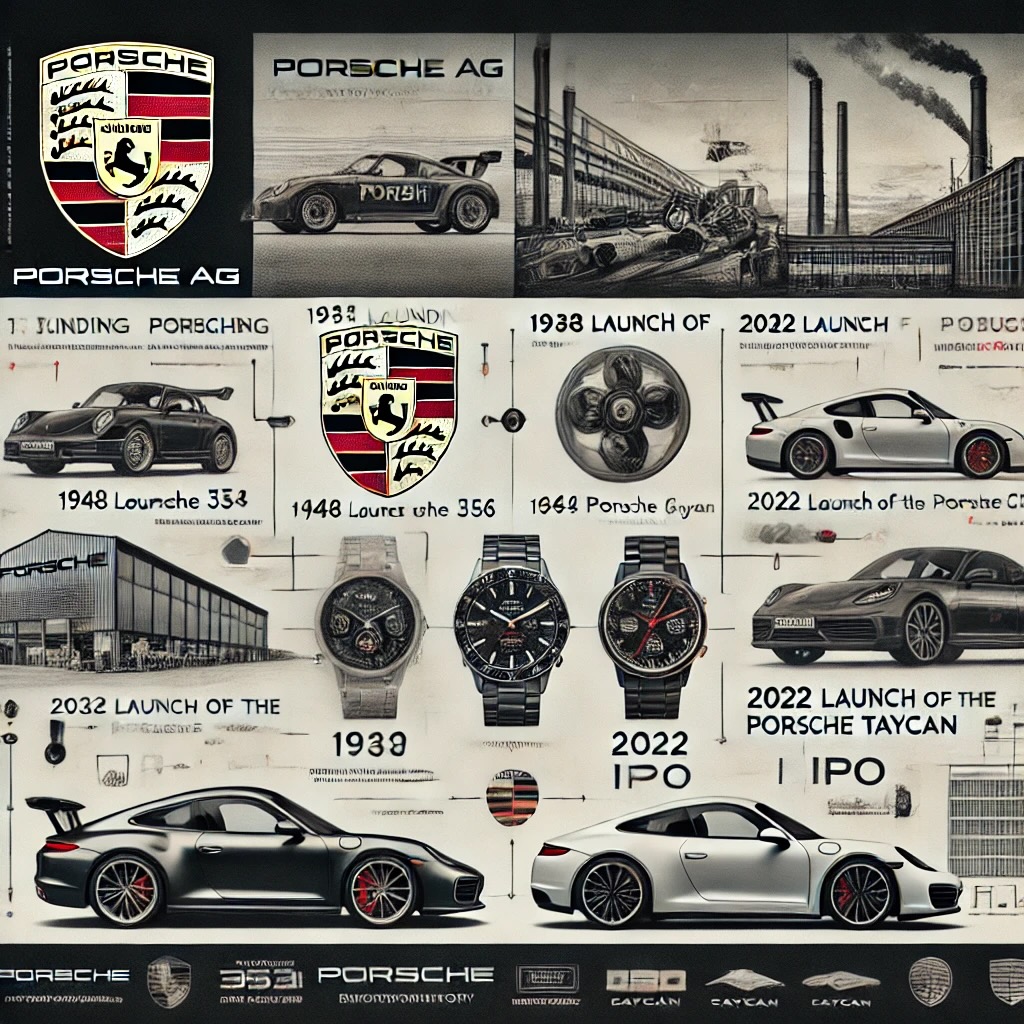
Porsche AG: Engineering Excellence and Automotive Legacy
Chapter 1: Introduction
Porsche AG, headquartered in Stuttgart, Germany, symbolises precision engineering, luxury, and performance. Founded in 1931 by Ferdinand Porsche, the company has grown into one of the world’s most respected automotive brands, known for its legendary sports cars, groundbreaking innovations, and commitment to sustainability.
Porsche’s journey is one of vision, resilience, and evolution. From its humble beginnings as an engineering consultancy to becoming a global leader in high-performance vehicles, Porsche has consistently pushed boundaries. With the launch of its first production car, the Porsche 356, in 1948 and the iconic Porsche 911 in 1964, the brand established itself as a pioneer in design and performance. Today, Porsche’s portfolio includes SUVs, sedans, and electric vehicles, reflecting its adaptability to changing markets and customer preferences.
For professional investors, Porsche’s history and strategies offer a compelling case study in brand management, technological innovation, and sustainable growth. The company’s 2022 IPO, one of Europe’s largest, underscores its financial strength and global appeal.
Chapter 2: Founding and Early History
Porsche AG was founded on April 25, 1931, by Ferdinand Porsche, a visionary engineer who previously worked for major automotive companies such as Daimler-Benz. The company, originally called Dr. Ing. h.c. F. Porsche GmbH, began as a design and engineering consultancy, offering services to other automakers.
Key Early Projects
- 1934 Volkswagen Beetle: Ferdinand Porsche’s design for the Volkswagen Beetle became one of the most successful cars in history, with over 21 million units produced.
- Military Vehicles (1930s-1940s): Porsche developed military vehicles, including the Kübelwagen and the Tiger tank prototype, showcasing engineering prowess while facing controversies due to the political climate of the era.
Chapter 3: The Birth of Porsche Sports Cars
The transition from consultancy to manufacturer began in 1948 with the launch of the Porsche 356, designed by Ferdinand’s son, Ferry Porsche. The 356 was a lightweight, rear-engine sports car that offered exceptional performance and handling.
The Porsche 356: A Game-Changer
- Design and Engineering: Aerodynamic design, advanced suspension, and a focus on driving pleasure.
- Production: Initially hand-built in a small workshop in Gmünd, Austria, before moving to Stuttgart due to growing demand.
- Market Success: The 356 gained popularity, establishing Porsche as a premium sports car manufacturer.
Chapter 4: Evolution of the Porsche Brand
The 1960s marked a turning point for Porsche with the introduction of the Porsche 911 in 1964. Designed as a successor to the 356, the 911 became the cornerstone of Porsche’s identity.
The Porsche 911
- Timeless Design: Sleek lines and a distinctive rear-engine layout.
- Performance: Equipped with an air-cooled, flat-six engine, setting industry benchmarks.
- Endurance Racing: Success in motorsports, including wins at Le Mans and Daytona, solidified its reputation.
Chapter 5: Diversification and Market Expansion
Porsche diversified its portfolio to appeal to a broader audience, introducing the Porsche Cayenne in 2002 and the Panamera in 2010.
Porsche Cayenne
- Market Impact: Porsche’s first SUV became a global bestseller, significantly increasing revenue and profitability.
- Controversy to Success: Initially criticized by purists, the Cayenne proved Porsche’s versatility.
Porsche Panamera
- Luxury Meets Performance: Combined Porsche’s performance DNA with luxury sedan features.
- Sales Impact: Attracted a new demographic and boosted sales in emerging markets.
Chapter 6: Financial Challenges and Resilience
Porsche faced significant challenges in the late 2000s, including a failed attempt to acquire Volkswagen. However, strategic decisions, such as integration into the Volkswagen Group in 2012, demonstrated resilience and stability.
The Volkswagen Saga
- The Attempt: Porsche began acquiring shares in Volkswagen in 2005, aiming for control.
- The Outcome: Financial and regulatory hurdles led to Volkswagen acquiring Porsche.
Chapter 7: Innovation and Electrification
Porsche’s commitment to innovation is evident in the launch of the all-electric Porsche Taycan in 2019 and hybrid variants of the Panamera and Cayenne.
The Porsche Taycan
- Performance and Sustainability: Electric performance without compromising driving experience.
- Market Reception: Established Porsche as a leader in the premium EV segment.
Hybrid Technology
- Integrated Systems: Combines performance with efficiency.
- Sustainability Goals: Aligns with Porsche’s mission to reduce its environmental footprint.
Chapter 8: Financial Performance and IPO
Porsche’s 2022 IPO, one of Europe’s largest, valued the company at approximately €75 billion, reflecting investor confidence.
Revenue and Profit Highlights
- 2021 Revenue: €33.1 billion.
- 2021 Operating Profit: €5.3 billion.
- IPO Proceeds: Significant capital raised for electrification and R&D.
Chapter 9: Sustainability and Corporate Responsibility
Porsche aims to achieve carbon neutrality by 2030, focusing on electrification, renewable energy, and sustainable materials.
Key Initiatives
- Mission E: Porsche’s electrification strategy.
- Factory Sustainability: Solar power and water recycling at its Zuffenhausen plant.
Chapter 10: Leadership and Strategic Vision
Under Oliver Blume’s leadership, Porsche balances tradition and innovation, focusing on electrification, digitalization, and global expansion.
Chapter 11: Motorsports Legacy
Porsche’s success in motorsports, including numerous endurance racing titles, remains integral to its brand identity.
Chapter 12: Future Prospects
Porsche’s future lies in its ability to innovate while staying true to its heritage. Its focus on electric vehicles, digital technology, and sustainable manufacturing positions it for continued success.