Introduction
Tesla, Inc., founded by Elon Musk and a team of visionary engineers, has redefined the automotive industry and spearheaded the global shift toward sustainable energy. From its inception, Tesla has been at the forefront of technological innovation, challenging the status quo and setting new benchmarks in electric vehicles (EVs), energy storage, and autonomous driving technology. This comprehensive analysis provides an in-depth look into Tesla’s journey, from its early challenges to its current dominance in the EV market. It offers investors a detailed understanding of the company’s financial performance, market strategies, and future growth prospects.
Chapter 1: Origins and Early History
The Foundation
Tesla was founded in 2003 by engineers Martin Eberhard and Marc Tarpenning to accelerate the world’s transition to sustainable energy. However, Elon Musk, who joined as Chairman in 2004, truly envisioned the potential for Tesla to revolutionise the automotive industry. Musk’s early investments and strategic vision were pivotal in setting Tesla on its path to becoming a global leader in EVs.
Early Challenges and Competitors
In its early years, Tesla faced significant challenges, including scepticism from traditional automakers, technological hurdles, and financial constraints. The road was anything but smooth, with the company enduring delays, cost overruns, and the pressures of scaling production. Entrenched in the internal combustion engine market, competitors like General Motors and Toyota viewed Tesla’s ambitions with doubt. However, Tesla’s unwavering commitment to innovation and its ability to attract talent across the industry allowed it to overcome these obstacles.
Early Financial Performance
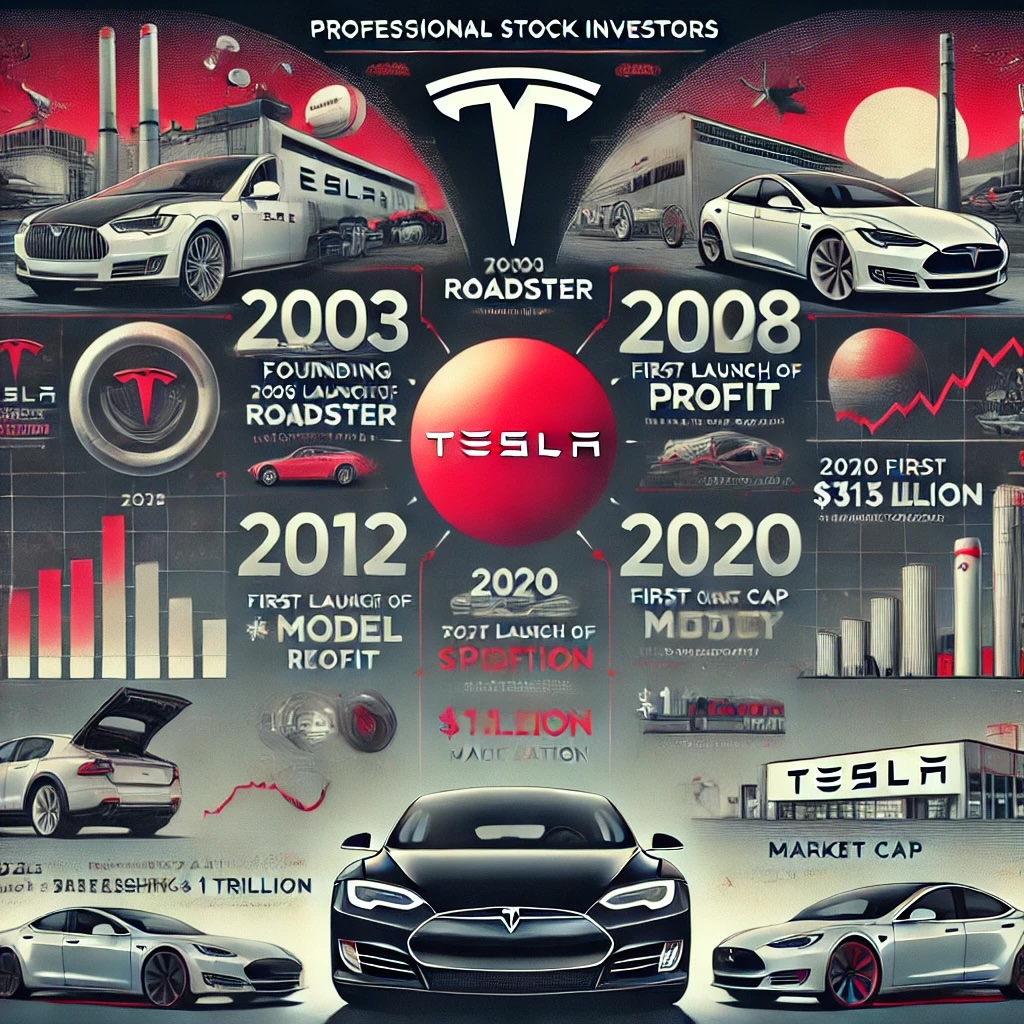
Tesla’s initial financial performance was marked by significant investment and development costs, which weighed heavily on its balance sheet. However, the company’s strategic focus on high-performance electric sports cars, exemplified by the launch of the Tesla Roadster in 2008, laid the groundwork for its future success.
2008: The Tesla Roadster, Tesla’s first production vehicle, was launched to much acclaim. The Roadster proved that electric vehicles could deliver high performance, dispelling the myth that EVs were slow and impractical. Despite its success, the Roadster was not a financial windfall, as development costs exceeded expectations, leading to significant financial strain.
Chapter 2: The Road to Mass Production
The Launch of the Model S
The introduction of the Model S in 2012 marked Tesla’s transition from a niche automaker to a mainstream competitor. With its sleek design, impressive range, and cutting-edge technology, the Model S was a game-changer for the industry. It was the first electric vehicle to offer a viable alternative to luxury sedans powered by internal combustion engines.
Scaling Challenges
Mass production brought new challenges for Tesla. The company needed help with the complexities of scaling its manufacturing operations, resulting in delays and quality control issues. However, Musk’s hands-on leadership and relentless focus on innovation kept the company moving forward.
Financial Milestones
Tesla’s financial milestones during this period were significant, reflecting the challenges of scaling production and the growing demand for its vehicles.
2012: The launch of the Model S significantly boosted Tesla’s revenues, with sales reaching $413 million by year-end. However, the company continued to operate at a loss as it reinvested heavily in research and development (R&D) and manufacturing capabilities.
2013: Tesla achieved its first profitable quarter in Q1 2013, marking a pivotal moment in its financial history. The company’s stock price surged, reflecting investor confidence in its long-term prospects.
Chapter 3: Expanding the Product Line
The Model X and Model 3
Building on the success of the Model S, Tesla expanded its product line with the introduction of the Model X in 2015 and the Model 3 in 2017. The Model X, an all-electric SUV, and the Model 3, a more affordable sedan aimed at the mass market, were critical to Tesla’s growth strategy.
Model X: The Model X featured innovative technology, such as Falcon Wing doors and a high-performance electric drivetrain, but its development was fraught with challenges, including production delays and higher-than-expected costs.
Model 3: The Model 3 was a strategic bet on the mass-market adoption of EVs. Priced to compete with mid-range sedans, the Model 3 was designed to be Tesla’s volume seller. Despite initial production bottlenecks, the Model 3 became a success, driving Tesla’s revenues to new heights.
Financial Performance and Stock Metrics
Tesla’s financial performance during this period was marked by both volatility and rapid growth. The Model 3, in particular, played a crucial role in turning Tesla into a profitable enterprise.
2017: The year 2017 was a turning point, with Model 3 production ramping up and Tesla’s revenue surpassing $11 billion. However, the company still faced significant challenges in achieving consistent profitability.
2018: Tesla reported its first full-year profit in 2018, driven by strong sales of the Model 3. The company’s stock price reflected this success, with Tesla’s market cap exceeding $60 billion by year-end.
Chapter 4: Innovation and Expansion
The Gigafactories
Tesla’s ambitious expansion plans included the construction of Gigafactories—massive production facilities designed to scale the production of batteries and vehicles. The first Gigafactory, located in Nevada, became operational in 2016, followed by additional Gigafactories in New York, Shanghai, and Berlin.
Gigafactory Nevada: The Nevada Gigafactory, a key component of Tesla’s supply chain, significantly reduced battery costs, enabling Tesla to price its vehicles more competitively.
Global Expansion: The Shanghai Gigafactory marked Tesla’s first foray into international manufacturing, allowing the company to tap into the lucrative Chinese market. The Berlin Gigafactory, meanwhile, underscored Tesla’s commitment to expanding its presence in Europe.
Energy Products and Solar
Beyond electric vehicles, Tesla has made significant strides in the renewable energy sector with its energy storage products and solar solutions. The acquisition of SolarCity in 2016 was a strategic move to integrate solar power generation with Tesla’s energy storage offerings.
Powerwall and Powerpack: Tesla’s Powerwall and Powerpack products have revolutionised energy storage, enabling homeowners and businesses to store solar energy for use during peak hours or outages.
Solar Roof: The Solar Roof, launched in 2017, represented Tesla’s vision of a fully integrated renewable energy solution, combining solar generation with energy storage and EV charging.
Financial Impact of Diversification
Tesla’s diversification into energy products and global manufacturing has profoundly impacted its financial performance.
2019: Tesla’s revenue from energy generation and storage reached $1.5 billion, reflecting the growing importance of this segment to the company’s overall strategy.
2020: Despite the challenges posed by the COVID-19 pandemic, Tesla’s revenue exceeded $31 billion, with the energy business contributing significantly to the company’s bottom line.
Chapter 5: Challenges and Resilience
Competitive Landscape
The automotive industry is highly competitive, with legacy automakers like General Motors, Ford, and Volkswagen investing heavily in electric vehicle technology. Tesla’s ability to maintain its market leadership is a testament to its innovative edge and brand strength.
Key Competitors
Legacy Automakers: Companies like Ford and Volkswagen have introduced their electric vehicles, but Tesla’s head start in technology and infrastructure has given it a significant competitive advantage.
New Entrants: Rivian, Lucid Motors, and other startups have emerged as potential competitors, particularly in the luxury EV segment.
Ethical and Legal Issues
Tesla’s rapid growth has also brought scrutiny regarding its business practices, particularly in labour relations, product safety, and regulatory compliance. The company has faced legal challenges and media criticism but has generally navigated these issues without significant long-term damage to its reputation or financial performance.
Labor Practices
Workplace Safety: Tesla has faced allegations of unsafe working conditions at its Fremont factory, prompting investigations and regulatory scrutiny. The company has responded by implementing safety improvements and increasing transparency.
Unionization Efforts: Tesla’s resistance to unionisation has sparked controversy, particularly in the U.S., where labour unions have historically been strong in the automotive industry.
Sustainability Initiatives
Tesla’s commitment to sustainability is central to its mission. The company has implemented a range of initiatives to reduce its environmental footprint, from sourcing renewable energy to recycling materials.
Key Sustainability Efforts
Battery Recycling: Tesla has developed proprietary technologies for recycling used batteries, reducing waste and lowering the environmental impact of its vehicles.
Carbon Neutrality: Tesla has committed to achieving carbon neutrality across its operations, with a focus on renewable energy and sustainable materials.
Financial Metrics and Performance Against S&P 500
Tesla’s financial performance has consistently outpaced the S&P 500, reflecting its market leadership and growth potential.
2019-2020: Tesla’s stock performance has been extraordinary, with a 700% increase in 2020 alone, driven by strong demand for EVs and investor optimism about the future of sustainable energy.
2021: Tesla’s market cap surpassed $1 trillion, making it one of the most valuable companies in the world and solidifying its position as the leader in the EV market.
Chapter 6: The Contemporary Era and Future Prospects
Leadership and Vision
Elon Musk’s leadership has been both a driving force behind Tesla’s success and a source of controversy. His bold vision, unorthodox management style, and ability to inspire both investors and employees have been key to Tesla’s meteoric rise.
Elon Musk’s Vision for the Future
Autonomous Driving: Tesla’s Full Self-Driving (FSD) technology represents Musk’s vision of a future where cars can operate without human intervention. Although FSD has faced regulatory and technical challenges, it remains a critical component of Tesla’s long-term strategy.
Interplanetary Ambitions: Musk’s vision extends beyond Earth, with plans to integrate Tesla’s technology into future missions to Mars. While these ambitions may seem far-fetched, they underscore Musk’s commitment to pushing the boundaries of innovation.
Recent Innovations
Tesla continues to innovate across multiple fronts, from vehicle design to energy solutions.
Key Innovations
Cybertruck: The launch of the Cybertruck, an all-electric pickup with a radical design, demonstrated Tesla’s willingness to challenge conventional automotive design and create new market segments.
Tesla Semi: The Tesla Semi, an all-electric truck designed for long-haul freight, represents Tesla’s entry into the commercial vehicle market. With promises of lower operating costs and reduced emissions, the Tesla Semi is poised to disrupt the trucking industry.
Financial Performance and Stock Metrics
Tesla’s financial performance in recent years has been nothing short of remarkable, with consistent revenue growth and expanding margins.
2020: Tesla reported revenues of $31.5 billion, with net income exceeding $721 million, marking its first full year of profitability. The company’s stock price reflected this success, with Tesla’s market cap surpassing $800 billion by year-end.
2021: Tesla’s stock continued its upward trajectory, supported by strong vehicle deliveries and robust demand for its energy products. The company’s market cap crossed the $1 trillion mark, cementing its status as a global technology leader.
Future Outlook
Tesla’s strategic vision for the future focuses on expanding its product lineup, enhancing its autonomous driving capabilities, and further scaling its energy business. The company’s commitment to sustainability and innovation positions it well for continued success in a rapidly changing global landscape.
Growth Opportunities
Global Expansion: Tesla plans to continue expanding its global manufacturing footprint, with new Gigafactories planned for India and other emerging markets.
Autonomous Driving: The development and deployment of Full Self-Driving (FSD) technology remain central to Tesla’s long-term strategy. Success in this area could unlock new revenue streams and solidify Tesla’s position as a leader in autonomous mobility.
Energy Solutions: Tesla’s energy business, including solar products and energy storage, is expected to grow significantly as global demand for renewable energy solutions increases.
Conclusion
Tesla’s journey is a testament to the power of visionary leadership, technological innovation, and strategic risk-taking. For investors, Tesla represents a unique opportunity to participate in the transformation of the automotive and energy industries. The company’s strong financial performance, market leadership, and commitment to sustainability make it a compelling investment for those looking to the future.
Added Key Financial Metrics and Performance Against S&P 500
2010s-2020s:
Stock Performance: Tesla’s stock has been one of the best-performing assets of the decade, consistently outpacing the S&P 500 and delivering exceptional returns to shareholders.
Profit Warnings: Despite facing numerous challenges, Tesla has managed to maintain strong revenue growth and profitability, recovering quickly from any setbacks.
2021 and Beyond:
Revenue Growth: Tesla’s revenue growth has been driven by its expanding product lineup, global manufacturing capabilities, and strong demand for EVs.
Stock Performance: Tesla’s stock has continued to outperform the S&P 500, with a significant boost from its inclusion in the index in late 2020.
Tesla’s history is a testament to the power of innovation, customer-centric strategies, and resilience. From its humble beginnings to its status as a global powerhouse, Tesla has consistently pushed the boundaries of what is possible in the automotive and energy industries. For investors, Tesla’s strong brand, commitment to quality, and ability to navigate challenges make it a compelling investment opportunity.
In conclusion, Tesla’s journey is one of vision, determination, and continuous reinvention. As the company looks to the future, it remains focused on providing exceptional value to its customers and shareholders, ensuring its legacy as a leader in the global automotive and energy markets.